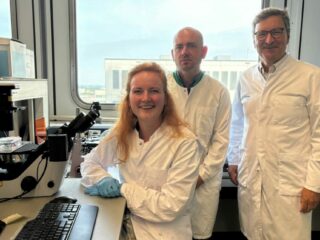

‘These results change the paradigm of thought,’ says lead researcher Arnab Ray Chaudhuri from the Department of Molecular Genetics at the Erasmus MC Cancer Institute. The discovery by Ray Chaudhuri and his colleagues led to a publication in Science , with Raviprasad Kuthethur as first author.
Chemoresistance
BRCA2 is a protein that plays an important role in repairing DNA damage. If it doesn’t function properly due to a genetic defect, DNA damage cannot be adequately repaired. The result: DNA damage accumulates, giving these individuals up to an 80% increased risk of breast cancer, up to a 20% increased risk of ovarian cancer, and a higher risk of prostate and pancreatic cancer.
BRCA2 tumors are often treated with targeted chemotherapy, such as PARP-inhibitors. This type of chemotherapy exploits the weakness of BRCA2-mutated tumors. Because these tumors cannot perform one form of DNA repair, they rely on another form to survive. PARP inhibitors block this alternative form of DNA repair. When both forms of DNA repair are disabled, the cancer cells die.
Yet sometimes a tumor manages to escape this mechanism. The tumor no longer responds to chemotherapy and continues to grow. This is called chemoresistance. When this happens, treatment options are often limited. Previous research showed that this was because BRCA2 tumors somehow manage to repair their DNA after all. But how they do this remained a mystery, until now.
Balance scale
Ray Chaudhuri and his team discovered that BRCA2 has a different role than previously thought. Ray Chaudhuri: ‘For nearly 25 years, it was believed that BRCA2 was essential for repairing DNA damage and that this form of repair was impossible without BRCA2. But that turns out not to be the whole story.’
‘These results change the existing paradigm of thought’
The true function of BRCA2 is more nuanced. It works together with another protein called FIGNL1. These two balance each other like weights on a scale: BRCA2 in one pan, FIGNL1 in the other. BRCA2 promotes DNA repair, while FIGNL1 inhibits it. Together, they keep the scale balanced, allowing DNA repair to occur properly.
Trick
When the BRCA2 protein doesn’t function properly, the scale is unbalanced. It tips toward FIGNL1. DNA repair is only inhibited, and the cancer cell cannot repair DNA damage. When cancer cells are then treated with PARP inhibitors, both forms of DNA repair are disabled and the cancer cells die.
Ray Chaudhuri and his colleagues discovered that BRCA2 tumors use a trick to repair their DNA anyway: they also remove FIGNL1 from the scale. This prevents the scale from tipping to one side, and the mechanism is free to operate again. The cancer cells can repair their DNA and survive chemotherapy: they become chemoresistant.
Back-up
Without BRCA2 and FIGNL1, cancer cells need other proteins to keep the scale balanced. They use these other proteins to fill the pans of the scale. These proteins act as a back-up: in the absence of BRCA2 and FIGNL1, they take over their roles.
This particular discovery may have major implications for the treatment of BRCA2-mutated tumors. Tumors that become chemoresistant need this back-up route to survive. ‘But if we also block these proteins, the entire mechanism collapses,’ Ray Chaudhuri explains. ‘This could make tumors sensitive to chemotherapy again. It opens new doors for targeted therapies against resistant BRCA2 tumors.’ Whether these therapies can actually be used still needs to be investigated.
This research is a multidisciplinary and multi-institutional project with key collaborations with the laboratories of Prof. Petr Cejka (IRB, Bellinzona, Switzerland), Dr. Shyam Sharan (NIH, USA), and Krishna Mohan Polluri (IIT Rourkee, India).