
Viral outbreaks are occurring in quick succession. Due to climate change and globalization, they have become more frequent in recent years. From COVID-19 to mpox, each outbreak highlights how important it is to quickly find effective medicines that can inhibit viral infections.
Researchers at Erasmus MC now demonstrate that organoids—small, lab-grown organs—can be used to more rapidly identify antiviral drugs during new outbreaks. In several studies, they show how technology has improved in recent years. For example, they can now produce more organoids, partly overcome limitations in drug testing with the help of artificial intelligence (AI), and make the models more authentic by adding immune cells.
The studies were published in Cell Reports Medicine, Science Advances, Communications Biology and PNAS. The current state, key challenges and future perspectives of organoids in advancing viral research are discussed in-depth in Nature Reviews Bioenginering.
Animal models and human cell lines
Currently, immortalized human cells (cell lines) or laboratory animals are used to study viral infections and test medicines. And while they are effective in their own regard, the models have limitations. ‘Cell lines and animal models provide a limited picture of what really happens in the human body,’ explains Dr. Qiuwei Abdullah Pan, principal investigator at the Department of Gastroenterology and Hepatology.
Cell lines often consist of just one type of cell with changed behavior, while the human body contains many different cell types and structures. And animals? They often do not respond to human viruses in the same way. As a result, it remains difficult to quickly and reliably determine which medicines will work in humans. In addition, there are many ethical reasons to minimize the use of laboratory animals. An alternative is needed.
Mini-organs
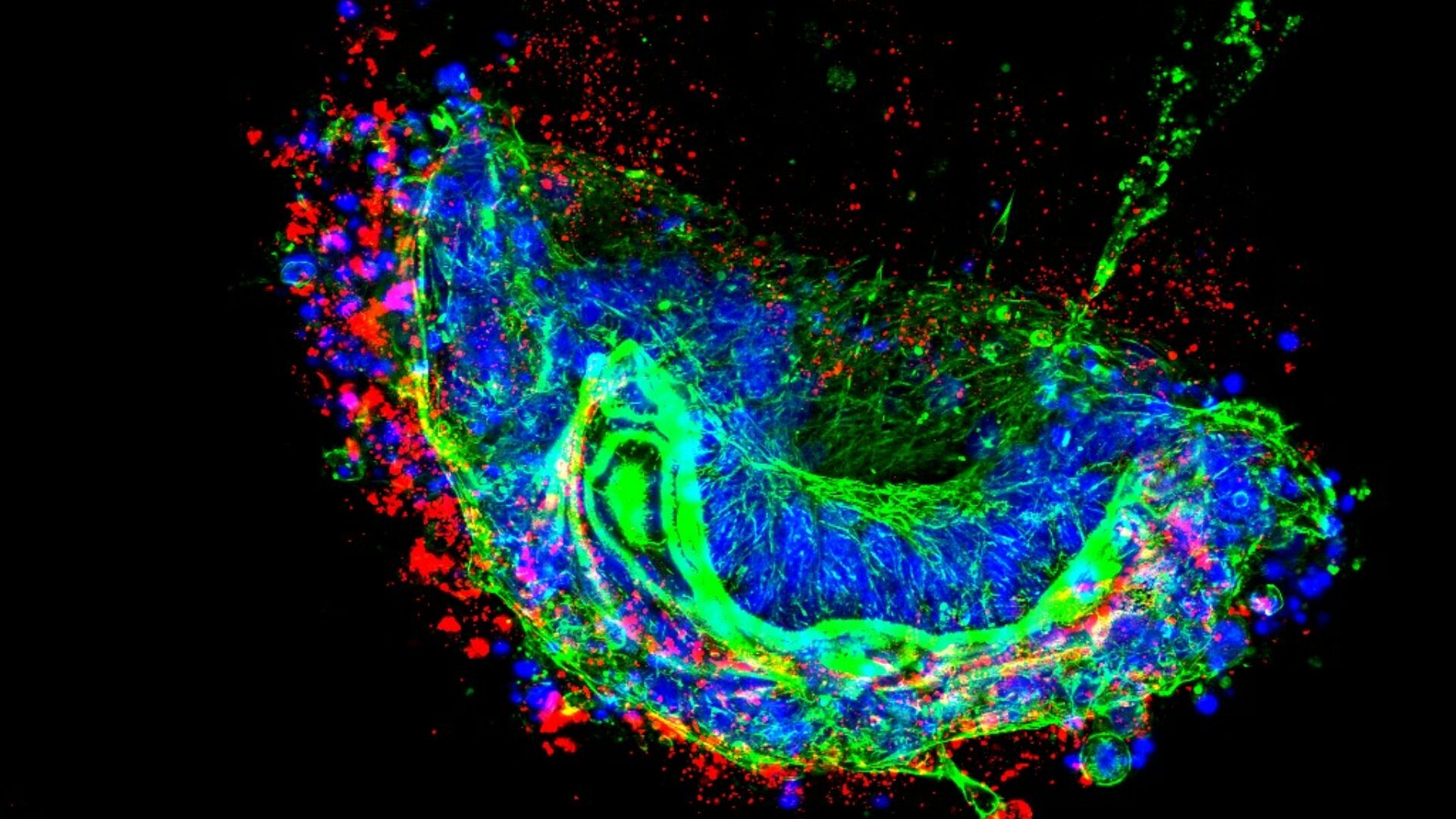
Organoids are small, lab-grown versions of human organs. They often consist of multiple cell types that together form a three-dimensional mini-organ. ‘With organoids, we can mimic what happens in the human body during a viral infection,’ Pan explains. ‘For example, we choose a specific organ, such as the intestine or the liver, depending on where the virus infects humans.’
Organoids have been around for some time, but their potential for antiviral drug discovery remains underexplored. There was a clear reason for this: the technology was not ready yet. Organoids are complex structures and therefore much more difficult to produce and maintain than immortalized cells. While researchers could test thousands of drugs at once using cell lines, organoid-based testing long remained limited to only a few candidates—until now.
‘We have developed a pipeline that allows us to expand the number of organoids and use them to screen drugs,’ says Pan. For example, Pan’s research group used liver organoids to replicate infection with the emerging Oropouche virus and identify an effective antiviral drug candidate. In intestinal organoids, they screened about 250 existing drugs, identifying several promising candidates against the monkeypox virus.
AI selection
Testing a few hundred drugs on organoids is already a major step forward. However, this is not enough for large-scale drug discovery. Therefore, the research group used AI to make an initial selection of potential candidates, then validate in organoids.
‘I knew little about AI, so I was amazed at how successful it was’
‘We collaborated with computer scientists to develop an AI pipeline that can digitally screen antiviral compounds,’ Pan explains. It worked surprisingly well. ‘I knew little about AI, so I was amazed at how successful it was. We obtained a short list of candidate drugs, and most of them showed activity against the monkeypox virus in organoids.’
Immune cells
The researchers are taking things a step further by making the organoids more physiologically relevant. Although organoids already better resemble the human situation compared to cell lines or animals, they are still not real organs. In viral infections, not only the virus itself matters, but also the body’s immune response. That is why researchers are now adding immune cells to organoids.
‘Patients don’t just get sick from the virus itself, but largely from the inflammatory response for many acute viral diseases,’ Pan explains. By adding immune cells, researchers can better understand how the virus and the immune system interact—and how this response can be controlled. This makes it possible not only to test antiviral drugs, but also combinations with anti-inflammatory drugs that can make the disease less severe.
Biomedical research
Through biomedical research, we work to understand basic biological and medical principles. This research is at the heart of medical progress and lays the foundation for innovations that improve care. As stated in Strategy28, Erasmus MC’s strategic plan.