
For a long time, scientists believed that most of our DNA had no function. However, this so-called ‘junk DNA’ appears to contain important switches that turn genes on or off. Researchers at Erasmus MC are using artificial intelligence to map these hidden switches. This approach makes it possible to find a genetic cause for rare brain disorders as well. They are publishing their findings in the leading scientific journal Cell.
Rare disorders
There are more than 8,000 rare genetic disorders. The majority of these have a genetic cause. Around 6 to 8 percent of the Dutch population has a rare genetic disorder. That is 1 million to 1.5 million people.
Thanks to recent developments in genetic testing, the possibilities of clinical genetics have increased enormously. It is now even possible to screen all of a patient’s genes in search of a diagnosis by means of whole genome sequencing. Earlier, this enabled researchers to discover the rare ReNU syndrome.
Non-coding DNA
However, in more than half of people with a rare disorder, it is not possible to find a genetic cause. This is because many of these new tests focus on a small part of the DNA: the 2% that codes for proteins. The remaining non-coding 98% was always known as ‘junk DNA’.
We now know that this non-coding DNA contains hidden switches that can turn genes on or off. Abnormalities in these so-called enhancers can also cause genes to work or not work. But because there is so much non-coding DNA, the search for these switches is like looking for a needle in a haystack.
Searching in an atlas
Erasmus MC researchers, led by clinical geneticist Stefan Barakat, brought structure to this search. They did this by first creating an atlas of all genetic switches in the brain. Using a technique they designed themselves, they mapped the entire genetic material of neural stem cells, the precursors of the brain. This yielded more than 140,000 functional switches.
The researchers then developed a predictive AI model to rank all the DNA building blocks within those switches according to their importance. That model, which they call BRAIN-MAGNET, gives a score: the higher the score, the more important the DNA building block of that switch is. And therefore, the greater the effect on disease in the event of a mutation of that building block.
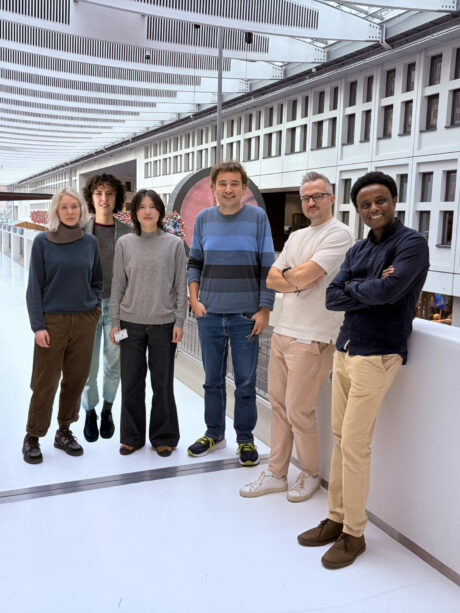
Part of the team behind the genetics research. From left to right: Anita Nikoncuk, Elena Perenthaler, Ruizhi Deng, Stefan Barakat, Gennady Roshchupkin, Eskeatnaf Mulugeta. Not on the picture: Soheil Yousefi, Kristina Lanko, Rachel Schot, Michela Maresca, Eva Medico-Salsench, Leslie Sanderson. . Photo adaptation: Esther Morren
How does that work? ‘We actually work the other way around’, says Barakat. ‘Previously, we could only sequence: determine the order of the DNA building blocks. We had to be lucky to find an abnormality. But we immediately look for mutations that can disrupt switches in patients without a diagnosis.’
Diagnosis as recognition
Barakat and his colleagues proved that the predictive model is able to link enhancers to genetic disorders by testing BRAIN-MAGNET on a British collection of genetic data. Out of 80,000 patients suspected of having a genetic neurological disorder, the model identified 800 patients for whom a genetic variant in the enhancer was the most likely cause of their disorder.
This trial with patient data offers prospects for clinical application, says Barakat. ‘With this method, we can prioritize which enhancers and their mutations may be involved in a disease. If we know which of these switches play a role, we can also make a diagnosis more easily. Patients often find that very reassuring.’ The fact that this is a rare disease for which there is often no direct treatment does little to change this. ‘Recognition of the symptoms is often more than patients had hoped for. A diagnosis often has a direct impact on medical treatment, and future therapies can also be developed once the cause is known.’
‘We can apply the same concept to other diseases’
Personalized treatment
For now, the method developed by Barakat and his colleagues is limited to neurological genetic disorders and finding probable diagnoses in that area. But that may change in the future. ‘These switches are found throughout the genome’, says the clinical geneticist. ‘If we train the model with other data, we can apply the same concept to other diseases.’
‘I hope that in ten years’ time we will have predicted the function of all genetic enhancers in the body’, says Barakat. ‘And that we will also be looking at the switches that turn genes off.’ That knowledge could predict why one patient develops a disease earlier than another. ‘Our approach can help predict disease progression and variation. That brings us one step closer to personalized treatments.’
On the picture, from left to right: Anita Nikoncuk, Elena Perenthaler, Ruizhi Deng, Stefan Barakat, Gennady Roshchupkin, Eskeatnaf Mulugeta. Not on the picture: Soheil Yousefi, Kristina Lanko, Rachel Schot, Michela Maresca, Eva Medico-Salsench, Leslie Sanderson.